Why Is E-commerce Growing, and Should Your Business Sell Online?
Web Design
6
min read
Published
(Last Edited:
)

E-commerce keeps growing because buying online has become easier than buying in person for a lot of everyday purchases. Phones, payments, delivery and social media have all removed friction at the same time.
Hong Kong shows both sides of that trend. In 2025, online retail sales grew by 12.8% to HK$35.7 billion while total retail sales grew by 1.0% to HK$380.5 billion, according to provisional figures from the Census and Statistics Department. That makes online about 9% of retail spending, so for most businesses an online store adds a sales channel rather than replacing the shop.
This article is for owners and marketing leads of small businesses who are wondering whether that growth applies to them. We explain the six drivers that matter, what each one means in practice, and when selling online is not worth it.
Six reasons e-commerce has grown so fast
None of these reasons is new on its own. What changed is that they all matured together, so a shopper can now find, pay for and receive a product without leaving the sofa.
1. The phone is now the shop window
Most people discover products while scrolling on their phone, then buy on the same device. A store that is awkward on a small screen loses those buyers at the moment they are ready to pay.
What it means for you: test your checkout on your own phone before anything else. Count the taps from product page to payment confirmation, and remove any field you do not actually need, such as a second address line or a mandatory account sign-up.
2. Paying online got faster and more familiar
Shoppers no longer need to type a card number for every purchase. Saved cards, digital wallets and local options such as FPS, PayMe and AlipayHK make paying a one-step action.
What it means for you: offer the payment methods your customers already use, not the ones that are easiest to set up. If you sell in Hong Kong, check early which methods your platform and payment gateway (for example PayDollar/AsiaPay) support, because adding one later can mean a new contract and a new integration.
3. Delivery became predictable
Couriers such as SF Express, plus locker and convenience-store pick-up, mean customers can choose when and where they collect an order. Predictable delivery removes one of the biggest reasons people hesitated to buy online.
What it means for you: decide your shipping rules before you launch. Set a flat rate or a free-shipping threshold, state the delivery time on every product page, and write a returns policy you can afford to honour.
4. Habits formed during the pandemic stuck
The pandemic pushed many people to buy groceries, gifts and household goods online for the first time. Once someone has saved an address and a payment method, the next order takes seconds.
What it means for you: the customer who "doesn't shop online" is much rarer than it was. It is still worth asking your existing customers how they would prefer to order, rather than assuming.
5. Social media and messaging shorten the path to purchase
Instagram and Facebook posts can link straight to a product, and many Hong Kong customers ask questions on WhatsApp before they buy. The distance between "I like that" and "I've paid" is now a couple of taps.
What it means for you: make every product link to its own page, so you can paste that link into a chat or a post. Add a WhatsApp button for pre-sale questions, and decide who on your team answers it and how quickly.
6. Opening a store costs less, and borders matter less
Hosted platforms such as Shopify let a small team run a store without managing servers. The same store can take orders from overseas, which is how many small brands reach markets they could never open a shop in.
What it means for you: low set-up cost is not the same as low running cost. Budget for the monthly platform fee, transaction fees, paid apps and the time to add products. If you sell abroad, plan languages early: an English and Traditional Chinese store needs translated product copy and hreflang tags, so search engines show each visitor the right version.
What the growth does not mean
A growing market does not mean your store will grow by itself. More businesses selling online means more competition for the same searches and the same advertising space.
A new store starts with no traffic. Plan how customers will find it, whether that is search, social posts, email to existing customers or paid ads, and budget time or money for it after launch, not just for the build.
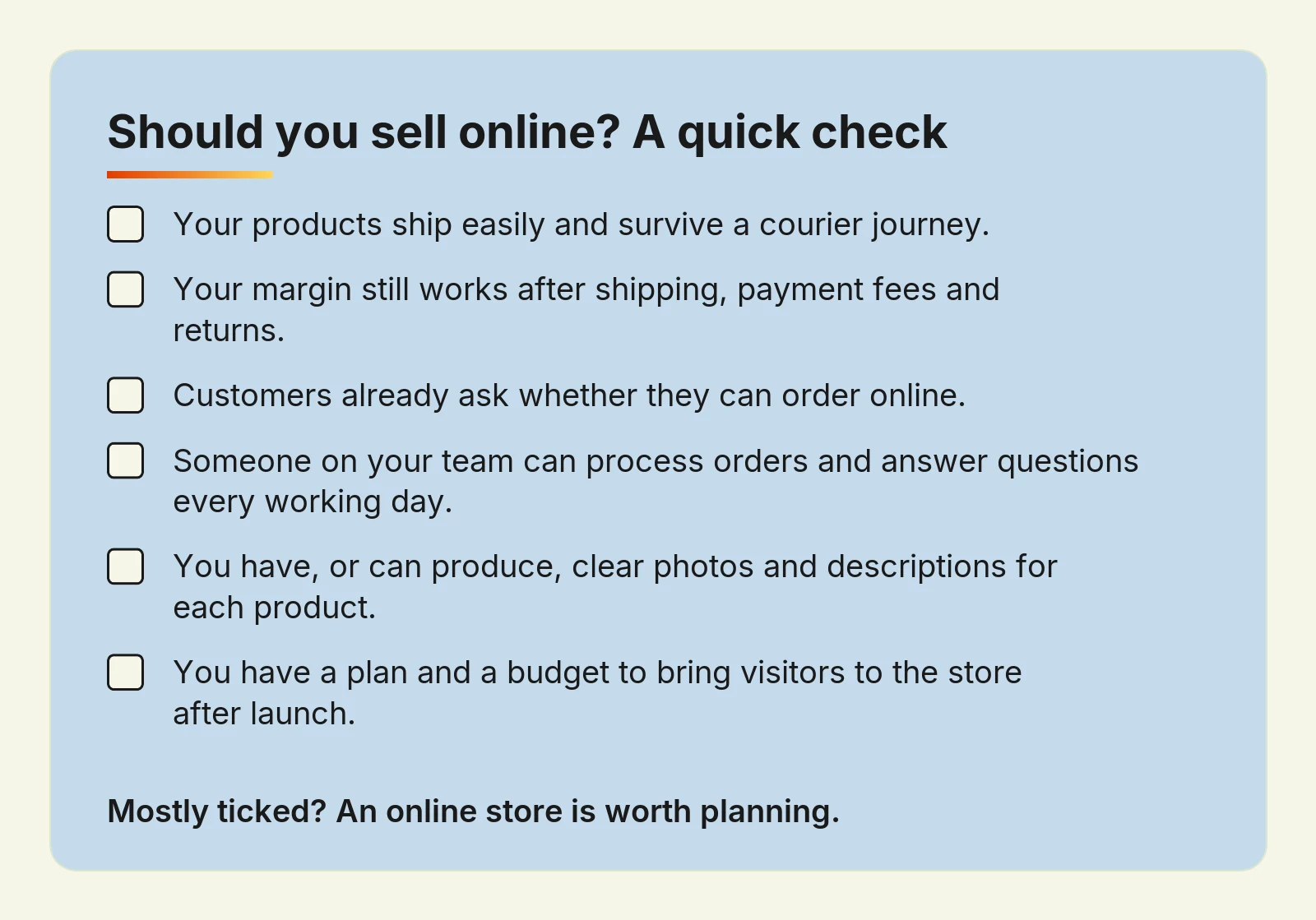
Should your business sell online? A quick check
Selling online tends to work when most of these are true:
Your products ship easily and survive a courier journey.
Your margin still works after shipping, payment fees and returns.
Customers already ask whether they can order online.
Someone on your team can process orders and answer questions every working day.
You have, or can produce, clear photos and descriptions for each product.
You have a plan and a budget to bring visitors to the store after launch.
It is often not worth it yet when you mainly sell services, when a few repeat business customers already order from you by WhatsApp or email, or when every item is one-off and needs a conversation. In those cases, a clear website with a price list, an enquiry form and FPS for payment may be all you need.
Choosing where to start
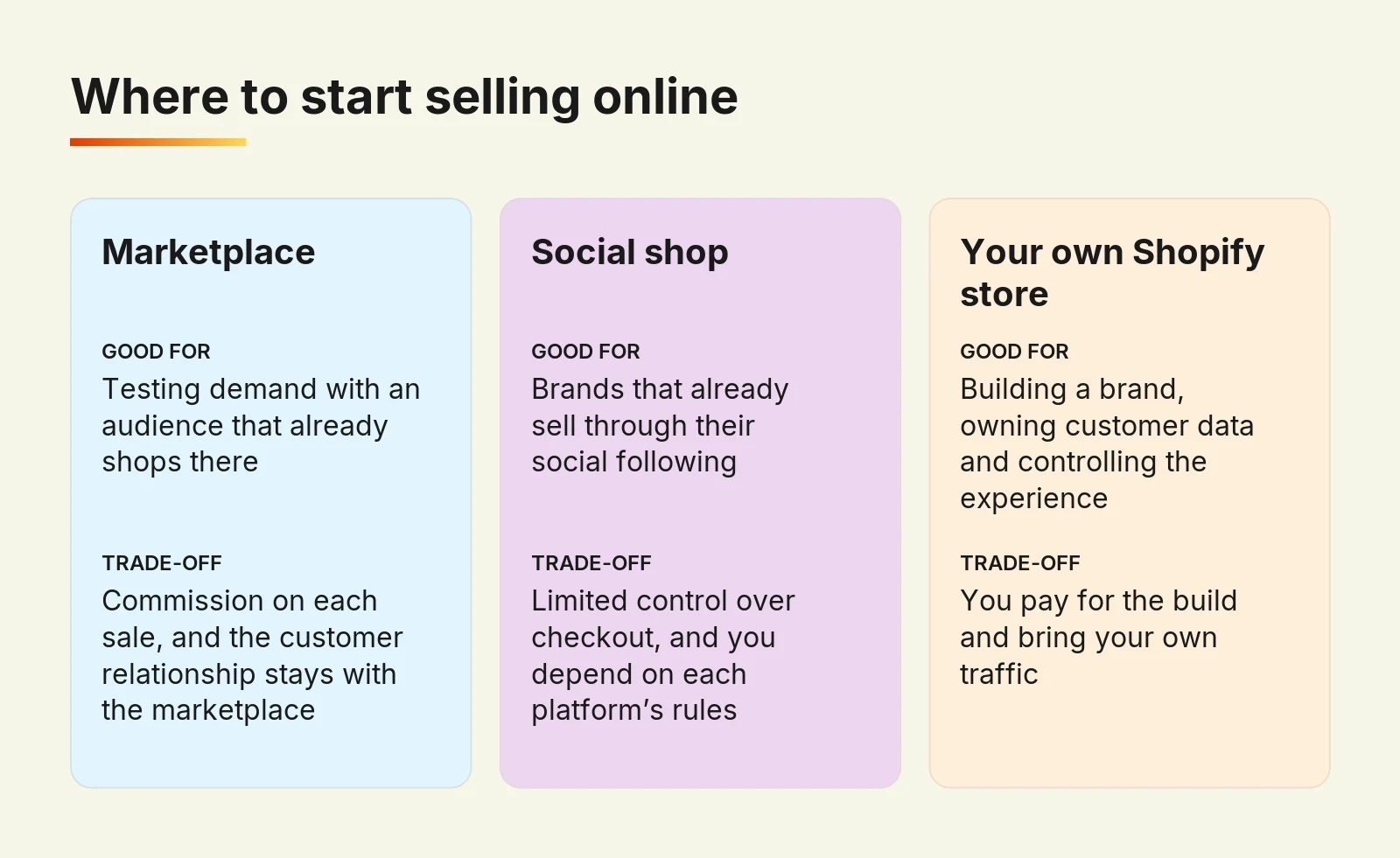
There are three common starting points, and each has a trade-off.
Option | Good for | Trade-off |
Marketplace, such as HKTVmall | Testing demand with an audience that already shops there | Commission on each sale, and the customer relationship stays with the marketplace |
Social shop on Instagram or Facebook | Brands that already sell through their social following | Limited control over checkout, and you depend on each platform's rules |
Your own Shopify store | Building a brand, owning customer data and controlling the experience | You pay for the build and bring your own traffic |
Many businesses combine them. A common path is to test demand on a marketplace or social shop, then move core customers to your own store once you know what sells. Before you build, our guide to setting up a Shopify store step by step shows what the work involves, and our look at e-commerce in Hong Kong specifically covers the local picture in more depth.
An online store can also be a new channel for an existing business rather than a replacement for it. Our frozen seafood Shopify build for Coast to Coast created a new sales channel, and our work opening a new market on Shopify for Les Cleia did the same for an established brand.
Frequently asked questions
Why is e-commerce so popular?
E-commerce is popular because buying online is often quicker and easier than visiting a shop. Shoppers can compare products, pay in one step with a saved card or wallet, and choose when and where to collect the order. Links from social media and messaging apps have also shortened the path from seeing a product to paying for it.
Is e-commerce still growing in Hong Kong?
Yes, online retail in Hong Kong is growing much faster than retail overall. Provisional Census and Statistics Department figures show online retail sales grew by 12.8% in 2025 to HK$35.7 billion, while total retail sales grew by 1.0% to HK$380.5 billion. Online is still about 9% of retail spending, so for most businesses an online store adds a channel rather than replacing the shop.
Why is e-commerce becoming more important for businesses?
E-commerce is becoming more important because more customers expect to research, compare and buy without visiting in person, and a business that cannot take orders online can lose them to one that can. It does not suit every business, though. Service firms and suppliers with a few repeat trade customers often do better with a clear website, an enquiry form and FPS for payment.
How can e-commerce help a small business grow?
E-commerce helps a small business grow by adding a sales channel that takes orders outside opening hours and beyond its local area, including overseas. The growth is not automatic. A new store starts with no traffic, so plan how customers will find it, whether through search, social posts, email to existing customers or paid ads, and budget for that after launch.
Do I need my own online store, or is a marketplace enough?
A marketplace is often enough to start, because it lets you test demand with shoppers who are already there. The trade-off is commission on each sale and a customer relationship that stays with the marketplace. Your own Shopify store costs more to set up and needs its own traffic, but you own the customer data and control the experience.
Your next step
Run the quick check above with your own numbers. If most of the points hold, list your ten best-selling products with their shipping cost and margin, as that list will shape almost every decision about your store.
When you are ready to plan the build, Digital Nova's Shopify development team has delivered more than 50 websites, and we will tell you plainly if a simpler option would suit you better. You can also talk to us about your store before committing to anything.

Government Funding for Websites in Hong Kong: What is Available?

5 Must-Have Features for Modern Websites in 2026
