Brand guidelines: what to include and how to make them work
Branding
7
min read
Published
(Last Edited:
)

Brand guidelines are the written rules for how your business looks and sounds. They tell anyone who makes something for you, from a new staff member to a printer or a freelance designer, which logo to use, which colours, which fonts and which tone of voice.
This guide is for owners and marketing leads of small Hong Kong businesses. After reading it, you will know what a useful set of brand guidelines contains, how long it needs to be, and what to check before you hand it to your team or your suppliers.
What brand guidelines are, and what they are not
Brand guidelines, also called a brand style guide, turn your visual identity into instructions. A logo file on its own does not tell anyone how much space to leave around it, which version to use on a dark background, or whether they can stretch it to fit a banner.
Guidelines are not the same as a brand strategy. Strategy decides who you serve, what you stand for and how you differ from others. Guidelines record how that strategy shows up on a page, a screen or a shopfront. If you have not worked through the strategy yet, our post on what a brand strategy covers is a better starting point.
You need guidelines as soon as more than one person produces material for your business. That moment comes early for most SMEs: an assistant posts on Instagram, a supplier prints name cards, and a developer builds the website.
What brand guidelines should include
A practical set has six parts. Each one answers a question your team or suppliers would otherwise ask you, or guess.

1. Logo rules
This is the section people use most, so make it the clearest.
Versions: the main logo, a horizontal or stacked alternative, a small icon for social profiles and the browser tab, and one-colour versions in black and white.
Clear space: the minimum empty area around the logo, usually measured as a part of the logo itself, such as the height of one letter.
Minimum size: the smallest width at which the logo stays readable, in millimetres for print and pixels for screens.
Backgrounds: which version to use on light, dark and photographic backgrounds.
Misuse: four to six examples of what not to do, such as stretching, recolouring, adding shadows or placing the logo on a busy photo.
If you only need the mark itself, with no wider system yet, a logo delivered in every format may be enough for now. Add guidelines when other people start using it.
2. Colour palette
List each brand colour with its codes for every medium: HEX and RGB for screens, CMYK for print, and a Pantone reference if you print signage or packaging where colour must match exactly. Say which colours are primary and which are accents, and roughly how much of each to use.
Check text colours for contrast. The W3C's accessibility standard asks for a contrast ratio of at least 4.5:1 for normal text and 3:1 for large text. Many pale brand colours fail this as text on white, so name the colour pairings that pass and mark the ones that are for backgrounds only.
3. Typography in English and Chinese
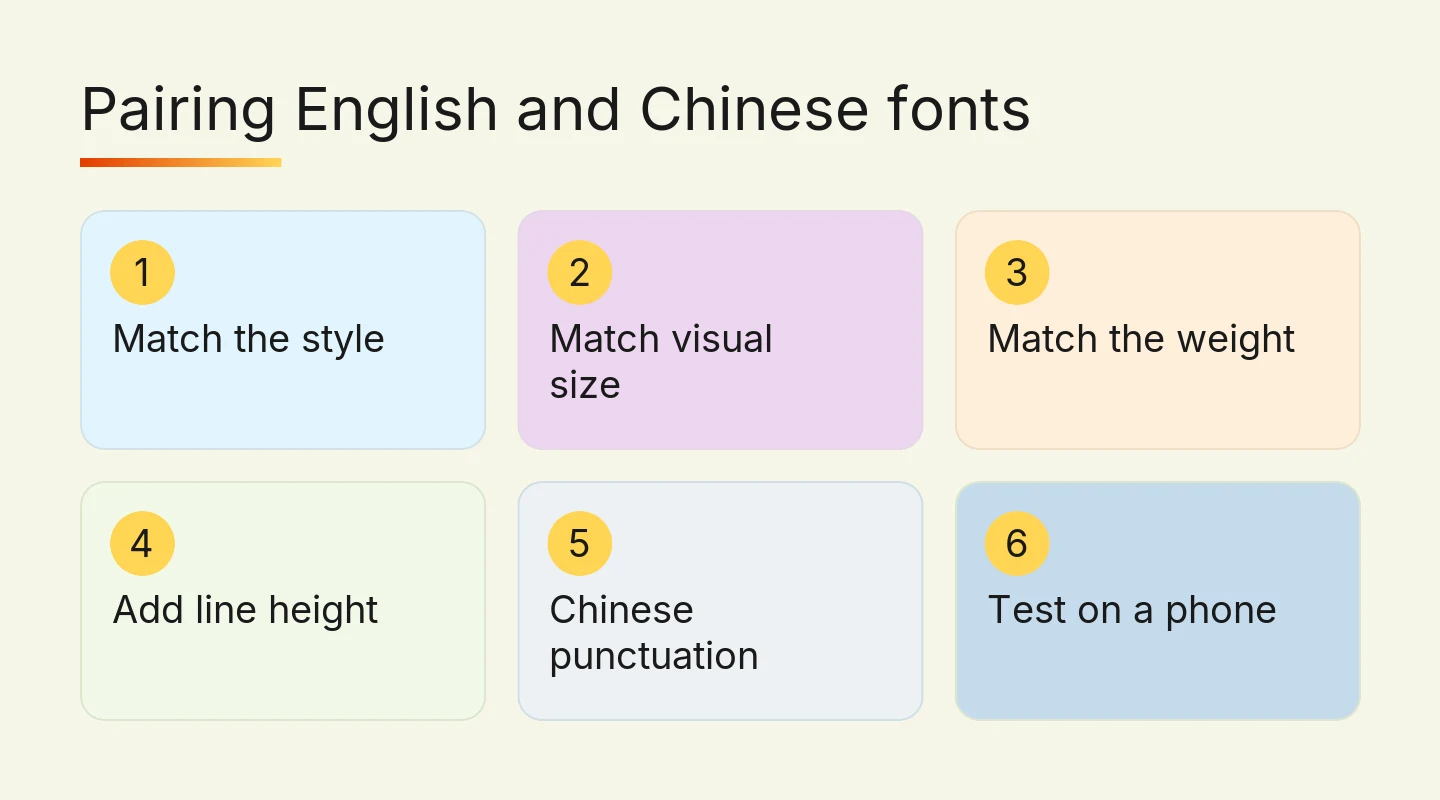
Name the fonts for headings and body text, with sizes, weights and line spacing for common uses. In Hong Kong, you also need a Traditional Chinese font that sits comfortably next to the English one, and a rule for which language comes first in a bilingual layout.
Check the licence before you choose. Commercial fonts are often licensed separately for desktop, web and app use. Free fonts under the SIL Open Font License can be used commercially, including in logos and printed material, with no extra permission. Google's Noto Sans CJK family, which covers Traditional Chinese, is released under that licence, which makes it a safe default for Chinese body text.
4. Bilingual logo lockups
If your business has an English and a Chinese name, show exactly how they sit together: side by side, stacked, or used separately. Give the size relationship between the two and the spacing. Without this rule, every supplier invents their own arrangement, and your shopfront, website and name cards stop matching.
5. Tone of voice
Describe how you write in a few plain rules, with examples. For instance: "We use short sentences. We say 'you', not 'customers'. We do not use slang." Show one sentence written the right way and the wrong way.
Cover both languages. Decide whether Chinese copy uses written Chinese or Cantonese, and where each is appropriate. A WhatsApp reply can be more casual than a quotation, so say how far the tone can move between channels.
6. Imagery and real examples
Describe the style of photos and graphics you use: people or products, natural light or studio, illustrations or none. Then show the rules applied to real items your team makes: a social post, a name card, a WhatsApp Business profile, an email signature and a Google Business Profile.
Examples help more than rules. Google, for instance, recommends JPG or PNG photos of 720 × 720 px, and at least 250 × 250 px, for Business Profile images. Put the exact file a staff member should upload next to that rule, and nobody has to guess.
How long should brand guidelines be?
Shorter than most people expect. A guide that nobody opens does not protect the brand. Match the length to how many people use the brand and how many places it appears.
One-page brand sheet | Full brand guidelines | |
Good for | 1–5 person businesses, mostly digital, with one person making most material | Teams of 10 or more, several suppliers, print, signage or packaging |
Contains | Logo versions, colour codes, fonts, three or four tone rules | All six parts above, with examples for each channel |
Trade-off | Quick to make and read, but leaves edge cases to judgement | Covers more situations, but takes longer to produce and keep up to date |

For many small businesses, a one-page sheet is the honest answer. You can grow it into a full guide when you open a second location, start printing packaging or hire a marketing team.
How to make brand guidelines your team will use
Writing the guide is half the job. These habits decide whether people follow it.
Put the files next to the rules. Link every logo version, font file and template from the guide. People break rules most often because the right file is hard to find.
Choose a format people open. A short PDF works for suppliers. A shared online page is easier to update for an internal team. Whichever you choose, keep one current version and remove old copies.
Give it an owner. One named person approves new material and answers questions. Without an owner, small exceptions add up.
Make templates for repeated work. Social post layouts, a presentation file and a quotation template remove most day-to-day decisions.
Review it once a year. Add rules for new channels and remove ones nobody needs.
Consistency is what lets customers recognise you across your website, social media and shopfront. Our post on branding that builds local trust explains why this matters for Hong Kong customers in particular.

Protect the logo your guidelines describe
Guidelines control how your logo is used, but they do not stop another business from using something similar. In Hong Kong, that protection comes from registering the logo as a trade mark with the Intellectual Property Department.
As of October 2026, the official filing fee is HK$2,000 for one class of goods or services and HK$1,000 for each additional class. A registration lasts 10 years and can be renewed for further 10-year periods. If you plan to register, do it before you print signage and packaging, in case your search finds a conflict.
What brand guidelines cost
You can write a one-page sheet yourself if your logo and colours are already settled. You need a designer when the identity itself is unclear, when you need a bilingual lockup, or when many suppliers will use the guide.
At Digital Nova, brand guidelines for your team come as part of identity work. As published on our service page, packages start from HK$8,000 for a logo and essentials, HK$20,000 for a full identity and HK$35,000 for a complete bilingual system, with a typical timeline of 3–8 weeks. The time goes into research, concepts and testing the system on real items, not into decorating the PDF.
Two of our projects show the range. For a luxury clothing store, we built the brand identity from scratch. For Foresight Sports Studio HK, we applied a new identity across the website, social posts and a pitch deck, which is exactly where guidelines earn their keep.
Frequently asked questions
What is the difference between brand guidelines and a brand style guide?
There is no real difference: most designers use brand guidelines and brand style guide for the same document. Some use "style guide" for a shorter version that covers only logo, colours and fonts, and "guidelines" for a fuller book that adds tone of voice and examples. What matters is the content, not the name on the cover.
What should logo guidelines include?
Logo guidelines should include every approved version of the logo, the clear space around it, the minimum size for print and screen, and which version to use on light, dark and photographic backgrounds. Good logo guidelines also show four to six common mistakes, such as stretching or recolouring, so suppliers can see what to avoid.
How many pages should brand guidelines have?
A small business often needs only one to five pages: logo versions, colour codes, fonts and a few tone rules. Larger teams with print, signage and several suppliers need a longer guide with examples for each channel. The right length is the shortest one that answers the questions your team and suppliers actually ask.
Can I create my own brand guidelines with a template?
Yes, you can write your own brand guidelines if your logo, colours and fonts are already decided. A template helps with structure, but it cannot fix an identity that does not work. A designer is worth it when you need a bilingual lockup, a Chinese name, or rules that many suppliers will follow.
How often should brand guidelines be updated?
Review brand guidelines about once a year, and update them whenever you add a new channel, product line, location or language. Most updates are small, such as a new template or a rule for a new social platform. A full rewrite is usually only needed after a rebrand.
Get brand guidelines your team can follow
Start today by collecting what you already have: your logo files, the colour codes your website uses, and two or three items you are happy with. That alone shows where the gaps are.
If you would rather have the identity and the guidelines built properly, in English, Traditional Chinese or both, see our brand identity packages or send us a short brief. We can run the project in Cantonese or English.